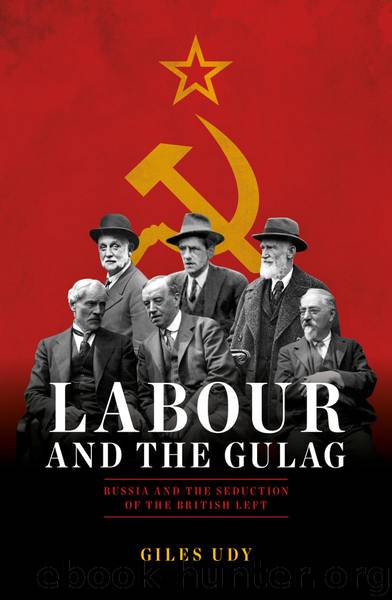
Labour and the Gulag by Giles Udy
Author:Giles Udy [Giles Udy]
Language: eng
Format: epub
ISBN: 9781785902659
Publisher: Biteback Publishing
Published: 2017-06-20T04:00:00+00:00
Foreign Office reaction
When Lord Charnwood consented to withdraw his motion he urged Henderson to allow Lang’s motion to be carried unopposed (without being put to a vote), as a sign of goodwill. Civil servants were wary of this and counselled against it. The government was bound to lose the debate and be forced to provide ‘papers’ anyway, but it was a concession to the archbishop and protesters that the officials were unwilling to make.
In the end, to the officials’ surprise, the government unexpectedly decided not to oppose the motion. ‘I had been under the impression that the motion was to be resisted and I am not sure of the exact reasons for acceptance’, Seymour wrote. H. L. Baggallay, another of the Northern Department staff, added that it was a ‘rather unexpected conclusion’ and ‘some sort of explanation should be given to Sir E. Ovey’.11
The reason became apparent in Henderson’s next dispatch to Ovey. From time to time throughout this affair, we have glimpses of Henderson’s intervention, often opposed by Dalton.§ This is one of those instances.
Your Excellency will observe that the motion of the papers was not resisted. This was partly because His Majesty’s Government have already decided that there were certain papers, that is to say, translations of Soviet legislation dealing with the question of religion, which they could properly lay before Parliament. But this was only a technical consideration.
The real reason was that His Majesty’s Government, although they do not accept much of what passes for evidence of religious persecution, and although they are aware that much that is called persecution does not, when properly understood, amount to persecution at all, are, none the less, unable to avoid the conclusion that the Soviet Government and the Soviet local authorities, in striving to secure the universal acceptance of beliefs which they had every right to hold or to propagate, are employing methods of discrimination which British and other opinion regards as substantially unjust.
To this extent His Majesty’s Government do not disassociate themselves, and have no wish to disassociate themselves, from public opinion in this country. That this is their attitude has, in fact, been evident throughout the controversy from replies to questions in Parliament and other public utterances of members of the Government. But His Majesty’s Government differ from the Lord Archbishop and others in his opinion as to the point at which they would be justified in interfering in the internal affairs of another Government because the methods of that Government do not comply with the standards which are accepted in this country.
You may, if necessary, make any use you think fit of this explanation, should the Acting Commissar for Foreign Affairs or any other member of the Soviet Government question you about the debate.12
Download
This site does not store any files on its server. We only index and link to content provided by other sites. Please contact the content providers to delete copyright contents if any and email us, we'll remove relevant links or contents immediately.
| Anthropology | Archaeology |
| Philosophy | Politics & Government |
| Social Sciences | Sociology |
| Women's Studies |
The Secret History by Donna Tartt(19103)
The Social Justice Warrior Handbook by Lisa De Pasquale(12197)
Thirteen Reasons Why by Jay Asher(8919)
This Is How You Lose Her by Junot Diaz(6894)
Weapons of Math Destruction by Cathy O'Neil(6284)
Zero to One by Peter Thiel(5808)
Beartown by Fredrik Backman(5767)
The Myth of the Strong Leader by Archie Brown(5513)
The Fire Next Time by James Baldwin(5454)
How Democracies Die by Steven Levitsky & Daniel Ziblatt(5225)
Promise Me, Dad by Joe Biden(5157)
Stone's Rules by Roger Stone(5091)
A Higher Loyalty: Truth, Lies, and Leadership by James Comey(4966)
100 Deadly Skills by Clint Emerson(4931)
Rise and Kill First by Ronen Bergman(4797)
Secrecy World by Jake Bernstein(4756)
The David Icke Guide to the Global Conspiracy (and how to end it) by David Icke(4723)
The Farm by Tom Rob Smith(4517)
The Doomsday Machine by Daniel Ellsberg(4493)
